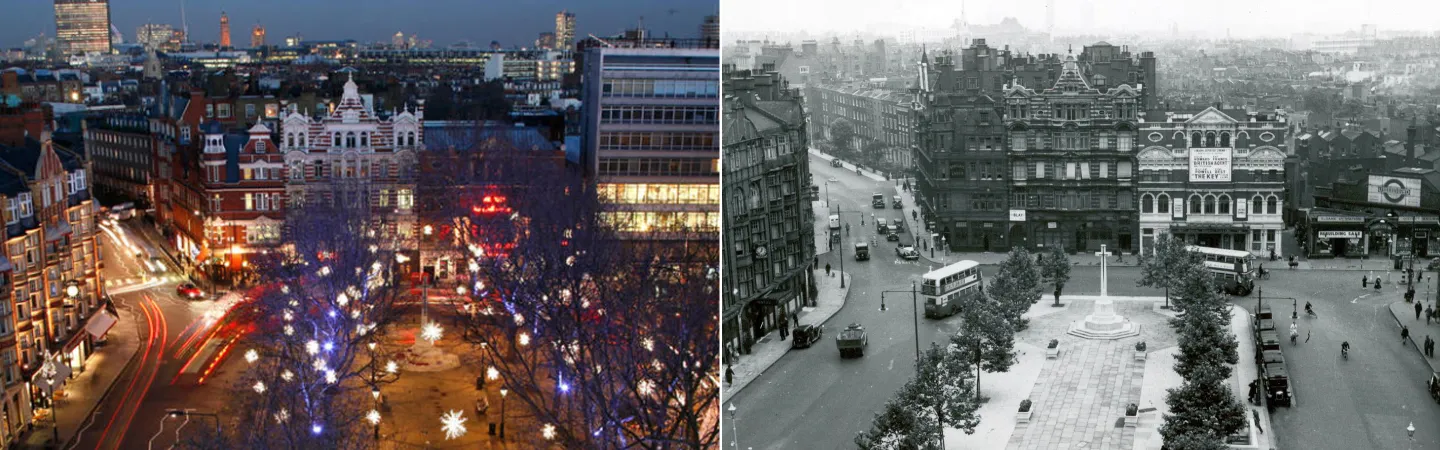
Long before the boutiques and cafés, Chelsea was a riverside settlement with a name that hints at its origins. “Cealchythe”, likely meaning a chalk landing place, appears in Anglo-Saxon records as early as 787AD. It was, quite literally, somewhere to arrive. For centuries, that remained its rhythm. Fields stretched down to the Thames, which was tidal and prone to flooding, and early life clustered around higher ground near what is now Chelsea Old Church.
It was here that Thomas More, Henry VIII’s chancellor, built his house, drawing the King’s attention to the area. Henry VIII was so taken with Chelsea that he acquired the manor in 1536, establishing a grand residence that would later be associated with Elizabeth I’s early years, and with Anne of Cleves and Katherine Parr. The house no longer survives, but its presence lingers, quietly marked by a blue plaque and the knowledge that Chelsea has long attracted those at the centre of things.
By the late 17th and early 18th centuries, Chelsea had become something of a rural retreat for London. Picture market gardens rolling towards the river and grand houses quietly observing the ebb and flow of boats. On fine days, visitors arrived by water to promenade in Ranelagh, breathe in the fresh air and take in the view. The Thames, now hard to imagine, was clear enough to fish for salmon. Chelsea, in short, was where London came to exhale.
Into this gently unfolding landscape came Sir Hans Sloane, a figure who feels almost too interesting to be real. Physician to monarchs, president of the Royal Society, collector of over 70,000 objects, and accidental pioneer of drinking chocolate, Sloane purchased the Manor of Chelsea in 1712. His motives were as much intellectual as practical. He needed space for his ever-growing collections, and Chelsea offered it. When he died, he left those collections to the nation, forming the foundation of the British Museum. Sloane brought intellect, curiosity and, crucially, a connection that would shape Chelsea’s future.
Through his daughter Elizabeth’s marriage into the Cadogan family, the estate passed into Cadogan hands. And this is where the story takes on real momentum. The Cadogans were not originally of London. Their name traces back to Cadwgan, a Welsh prince whose name translates, rather gloriously, as “battle keen”. Over centuries, the family’s fortunes shifted, taking them through Ireland and into military and political life. William Cadogan rose through the ranks during the War of the Spanish Succession, earning distinction at the Battle of Blenheim and ultimately the title of 1st Baron, and then 1st Earl Cadogan. What he and his successors inherited in Chelsea was not simply land, but a rare opportunity to shape a place over time.
That opportunity was seized with remarkable clarity in 1777. Charles, (3rd Baron, 1st Earl Cadogan NC), entered into an agreement with the architect and developer Henry Holland to create an entirely new quarter on open land north of the King’s Road. The plan was ambitious, covering 89 acres. Yet what makes it remarkable is not its scale, but its coherence. Streets were laid out with intent. Routes were defined. Sloane Street was created as a central spine, connecting Knightsbridge with the King’s Road, while Sloane Square replaced a far less appealing crossing over the River Westbourne.
This was Hans Town, and it changed Chelsea completely. Houses rose in measured terraces, elegant but not ostentatious. The area quickly became fashionable, attracting residents who valued space, order and proximity to London without its immediate intensity. It attracted thinkers, writers and observers of human behaviour. Jane Austen, visiting her brother on Sloane Street, edited the proofs of Pride and Prejudice here.
What is striking is how enduring that framework has been. Much of the street pattern established in the late 18th century still shapes Chelsea today. It feels intuitive because it was, from the beginning, thoughtfully designed.
By the mid-19th century, however, Chelsea was facing a familiar problem. Success had softened into stagnation. Buildings were ageing, the river had lost its clarity, and changes upstream had made it far less appealing. The area risked slipping from fashion.
Enter the 5th Earl Cadogan, who approached Chelsea not with nostalgia, but with conviction. The timing was fortuitous. Infrastructure improvements such as the Thames Embankment and the arrival of the Underground at Sloane Square were reconnecting Chelsea to a rapidly expanding London. Where others might have hesitated, he saw opportunity.
His response was both practical and quietly radical. Instead of replicating the architectural style seen elsewhere in London of uniform, beige Italianate stucco, he championed a richer, more expressive approach. Red brick replaced rendered facades. Decorative detail returned. Buildings began to feel individual again. This style, later known as “Pont Street Dutch”, gave Chelsea texture and personality, and has since become one of its defining characteristics.
It was also, importantly, a collaborative moment. Artists and craftspeople contributed to façades and interiors, embedding creativity into the fabric of the neighbourhood. Chelsea became not just a place to live, but a place to make and to think. That spirit has never quite left.
Alongside this transformation came a clear sense of responsibility. Schools, churches, libraries and civic buildings were supported and built, ensuring that Chelsea remained a community as well as a destination. This balance between stewardship and evolution has defined Cadogan’s role ever since.
At the same time, Chelsea was becoming something else entirely. It was, quite unmistakably, an artistic quarter. J.M.W. Turner, Whistler and Rossetti all lived and worked here. Writers such as Oscar Wilde, Thomas Carlyle and George Eliot brought their own particular kind of drama to the streets, while studios, music halls and gathering places attracted a mix of bohemians, thinkers and socialites. There was creativity in the air, occasionally genius, occasionally chaos, often at once.
This restless, creative energy continued to evolve. By the 20th century, Chelsea once again found itself at the centre of cultural change. The King’s Road became synonymous with the Swinging Sixties, as Mary Quant’s “youthquake” shook up fashion and attitudes in equal measure. Time magazine declared London the place to be, and Chelsea was very much in the middle of it, hosting a parade of style, music and unapologetic self-expression. In the years that followed, it became home to mods, punks and some of the most influential names in music, from The Rolling Stones and The Beatles to Led Zeppelin. At various points, it has been impossibly chic, faintly rebellious, and occasionally both.
Today, Chelsea continues to shift and adapt, but always within the structure set down over centuries. Its appeal lies as much in this continuity as in its change. There is a sense that things are considered here that decisions echo forward.
If Chelsea feels quietly distinctive, perhaps even a little self-assured, it is because it has been shaped that way. Not all at once, but steadily, thoughtfully, and with confidence to break the rules when it matters.